AI shopping is here: How to prepare your Shopify store for agentic commerce
What agentic commerce means for Shopify merchants, what Shopify is building for AI shopping, and four things to review in your store today so AI assistants recommend your products.

AI is becoming a new way for customers to discover and buy products. Whenever I need to buy a product I search on ChatGPT first because it is easier than going through comparison blogs and videos and ending up more confused.
In this article, I am going to share what Shopify merchants need to know and how to prepare.
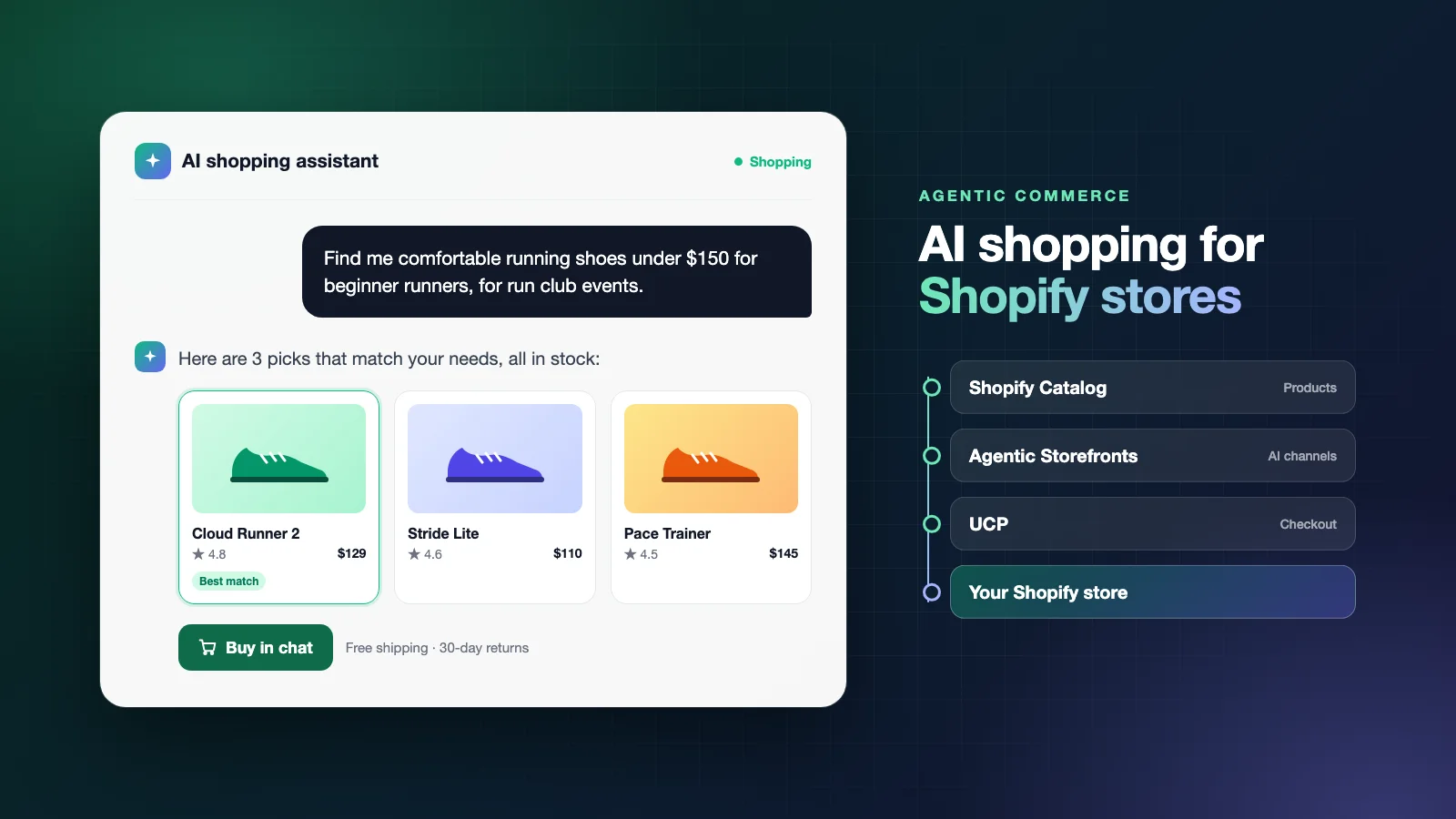
Imagine a customer asking ChatGPT, “Find me a comfortable, cool-looking pair of running shoes under $150 that are good for beginner runners, so that I can use them in run club events.”
Instead of searching Google, visiting multiple stores and comparing products manually, the customer receives personalized recommendations from an AI assistant. They can even complete their purchase without going to your website.
This is agentic commerce, and it’s already changing how people shop online.
In more dictionary terms, agentic commerce is when AI assistants help customers find, compare and purchase products based on their preferences.
Traditional ecommerce relies on customers going through the content on the website and understanding the nuances. Agentic commerce changes that and introduces another path, where customers explain what they need and AI helps them find the right product, just like a shopping assistant, but perhaps more objective and fact-based.
This creates a new need for stores: products now need to be understandable by AI shopping agents and I am going to share how you can make your products understandable below.
What is Shopify doing about it?
Shopify is a great company that invested in AI early on and has made huge improvements both in the Shopify admin and in agentic commerce. It is building the infrastructure to connect merchants with AI shopping platforms, including ChatGPT, Microsoft Copilot, Google’s Gemini and others.
Three important technologies make this possible:
- Shopify Catalog: makes product information available in a structured format that AI shopping platforms can use.
- Agentic Storefronts: allows eligible merchants to make products available through supported AI channels and manage their participation from the Shopify admin.
- Universal Commerce Protocol (UCP): an open standard co-developed by Shopify and Google that helps AI agents interact with product catalogs and checkout systems.
The goal is to make buying from a Shopify merchant possible wherever the customer discovers a product, even outside the merchant’s website.
How to prepare your Shopify store
The good news is that Shopify does most of the work for you out of the box. However, as with everything, there are things that need attention and adjustments. Here are four things worth reviewing today.
1. Improve your product descriptions
AI assistants need detailed product information to make relevant recommendations.
Go beyond generic descriptions. Include materials, dimensions, compatibility, intended use and answers to common customer questions. Add where customers can use it, who they can gift it to and why it is a perfect fit for them. Answer the questions they might ask an AI assistant. You don’t have to make those all visible in the UI, but make sure they are in the product description or in Knowledge Base so AI can read them.
2. Keep your store policies up to date
Customers regularly ask AI assistants about shipping costs, delivery times, returns and warranties. In our testing for some of our clients, we realized AI wasn’t able to figure out that a store had free shipping. Its shipping policy page was out of date, and AI was pulling the data from there. Updating the shipping policy fixed the wrong information AI was giving. Small changes make the biggest impact.
3. Review your Shopify Knowledge Base
This is the most important one. Shopify provides a Knowledge Base where merchants can review the information AI agents use to answer questions about their business.
Open Shopify admin → Agentic → Knowledge Base and review the available information. You can also click this link: https://admin.shopify.com/apps/agentic/knowledge-base
Make sure all the relevant information here is published and added correctly.
4. Improve your product category metafields
Go to your products and review the suggested category metafields. They give AI assistants useful information to refer to when a question is asked.
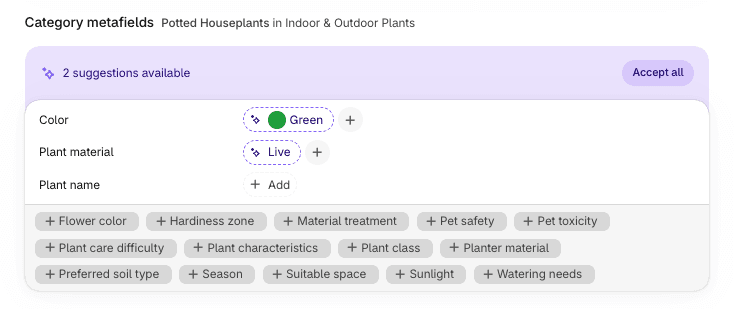 Suggested category metafields for a potted houseplant in the Shopify admin
Will agentic commerce replace ecommerce websites?
Not entirely, because people will still want to see more details and scroll through the options on your website before they trust it.
However, AI shopping introduces another free traffic channel, one that merchants shouldn’t ignore.
Just as brands adapted to Google Shopping, social commerce and mobile shopping, they’ll increasingly need to consider how their products appear in AI-generated recommendations.
Final thoughts
AI is improving and playing a bigger part in our lives, for the good. For ecommerce, it is replacing the way customers search for and compare products.
What you need to do?
For now, the best starting point is simple: keep your product information accurate, provide useful details, and make sure AI assistants can understand what makes your products worth recommending. Think about how people search for your product and what they could ask AI, and answer those kinds of questions in your product descriptions and Knowledge Base.
Tags
- Agentic commerce
- AI shopping
- Shopify agentic commerce
- Shopify Agentic Storefronts
- Shopify Catalog
- Universal Commerce Protocol
- UCP
- Shopify Knowledge Base
- Shopify category metafields
- Sell on ChatGPT Shopify

Written by
Ismail Namdar
Founder at Palmiyes
Ismail leads every project from the first call through architecture and launch ensuring quality at every step.
More about Ismail